
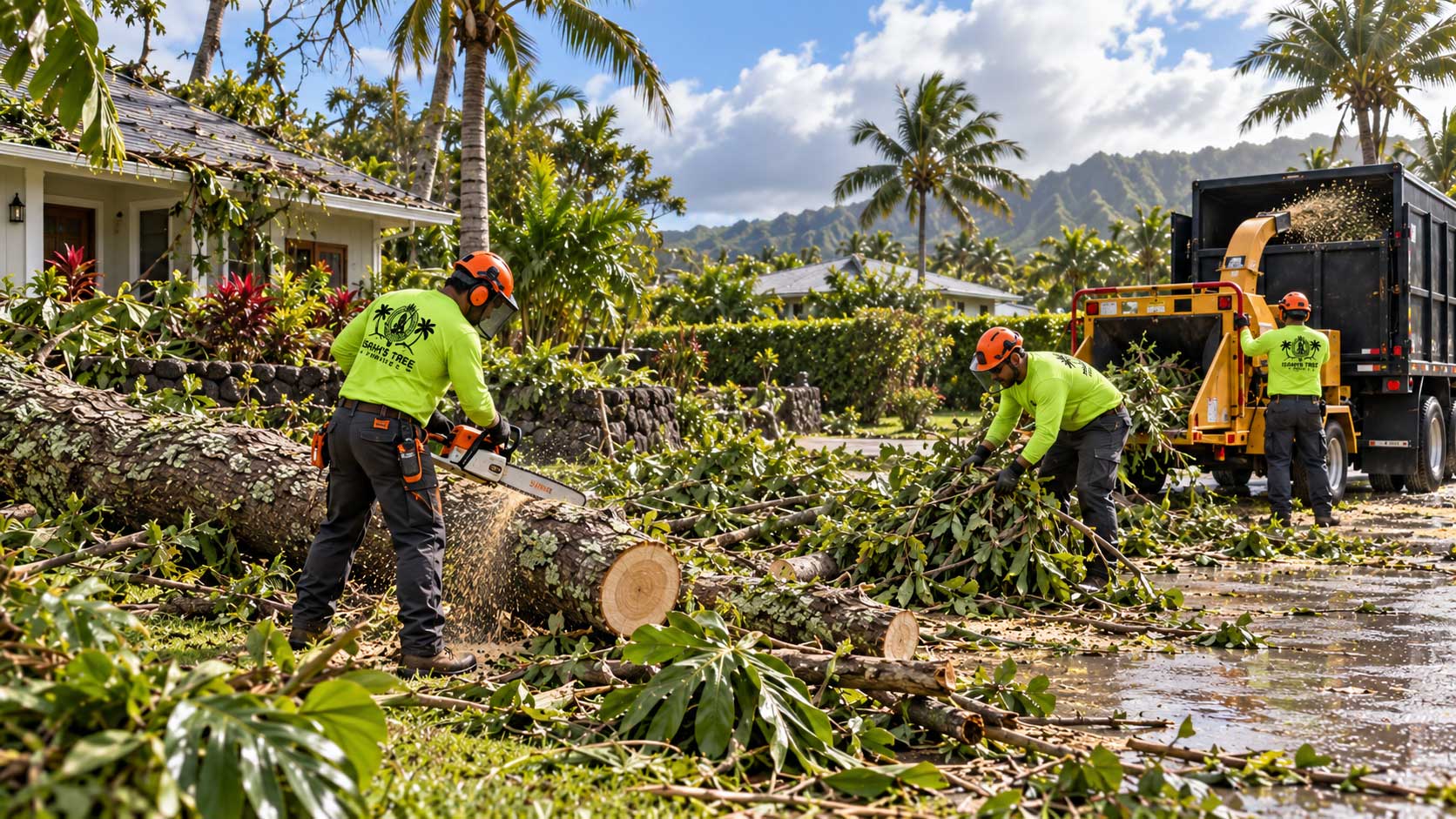
Hurricane Lowell left properties across Kauaʻi with fallen trees, broken limbs, damaged palms, blocked access, and large amounts of green waste. Some hazards are obvious, but others—such as cracked branches suspended in a canopy, loosened root systems, or a tree leaning toward a home—may not be apparent from the ground. Prompt evaluation and professional cleanup can help prevent additional property damage, reduce the risk of injury, and give storm-damaged trees their best opportunity to recover.
For post-hurricane tree cleanup anywhere on Kauaʻi, call Isaiah’s Tree Service at (808) 631-6488. Isaiah’s Tree Service provides island-wide emergency tree service, including hazard reduction, tree trimming and removal, site cleanup, and hauling away tree debris. Calling is the best way to request faster scheduling during the recovery period.
What should you do about a storm-damaged tree after Hurricane Lowell?
Keep people, pets, and vehicles away from damaged trees until the area can be evaluated. Do not walk or work beneath hanging limbs, attempt to remove large branches, or approach any tree that is touching or near a utility line. If it is safe to do so, photograph the damage from a distance for your records and insurance claim, then contact a qualified tree care provider.
Professional evaluation is especially important when a tree:
- Has large, broken, split, or hanging limbs
- Is leaning more than it did before the storm
- Has exposed, lifted, or visibly damaged roots
- Has a split trunk or cracked branch union
- Is resting on a home, roof, fence, vehicle, driveway, or access road
- Is tangled with utility lines or located near damaged electrical equipment
- Has lost a substantial part of its canopy
- Blocks a driveway, roadway, or safe access to the property
All utility lines should be treated as energized. Never try to move a limb or tree that is in contact with a power line. Call 911 for an immediate threat to life and report utility hazards to the appropriate utility provider.
Removing tree hazards can prevent a second round of damage
Hurricane winds can leave branches partially attached, twisted, or caught in neighboring limbs. These damaged sections may remain overhead until gravity, additional rain, or even moderate wind causes them to fall. Saturated soil can also reduce root stability, allowing a tree that survived the strongest winds to lean or fail later.
That is why storm cleanup involves more than picking up what has already fallen. A professional tree crew should examine the canopy, trunk, major branch unions, root area, and the direction in which a compromised tree or limb could fall. The immediate goal is to identify and control hazards before they cause additional injury or damage.
The International Society of Arboriculture’s storm-damage guidance advises property owners to assess the damage, take safety precautions, avoid hazardous do-it-yourself work, and obtain qualified help. Storm-damaged tree work is particularly dangerous because broken wood can be under extreme tension or compression. A branch can split, roll, spring, or fall unexpectedly when cut.
Correct pruning may help a damaged tree survive
Not every damaged tree needs to be removed. Depending on the species, age, location, structural condition, and extent of canopy or root damage, some trees can recover with carefully planned pruning.
Proper pruning removes broken, torn, or unstable limbs while preserving as much healthy canopy as reasonably possible. Clean, correctly placed cuts can limit additional tearing and help the tree close wounds more effectively. Selective pruning can also restore balance and reduce the weight carried by compromised limbs.
More cutting is not necessarily better. Severe over-pruning or topping removes foliage the tree needs to produce energy and can stimulate weakly attached new growth. According to Texas A&M Forest Service guidance on storm-damaged trees, damaged trees should not be indiscriminately topped, and healthy branches should be retained whenever possible to support recovery.
When damage is too extensive, complete removal may be the safest and most responsible recommendation. This may be the case when the trunk is severely split, major roots have failed, the tree has an unacceptable lean, or enough of the crown has been lost that safe recovery is unlikely. A professional assessment helps distinguish a tree that can be restored from one that now presents an ongoing hazard.
Complete cleanup includes removing and hauling the debris
Cutting a fallen tree or broken limb is only part of the job. Hurricane cleanup can leave behind heavy logs, tangled branches, palm fronds, wood chips, and piles of green waste. Handling that material yourself may require repeated loading, transportation, equipment, and compliance with changing disposal-site instructions.
A full-service tree company can manage the work from the first controlled cut through the final cleanup. That may include:
- Removing fallen or unstable trees
- Pruning broken and hazardous limbs
- Clearing driveways and other access points
- Chipping branches and vegetation
- Cutting larger wood into manageable sections
- Grinding stumps when appropriate
- Loading and hauling tree debris away from the property
- Leaving the work area safer, cleaner, and easier to use
This coordinated approach saves property owners time and avoids leaving a large debris pile that must be dealt with later. Isaiah’s Tree Service uses commercial tree-care and material-handling equipment—including bucket trucks, chippers, dump/chipper trucks, excavators, and a commercial stump grinder—to perform both the tree work and the cleanup. When feasible, removed tree material is recycled or repurposed, including wood that can be reused and chipped material that can serve as mulch.
Kauaʻi County continues to publish current information about road conditions, green-waste sites, recovery resources, and other storm-related changes on its official Hurricane Lowell recovery updates. Property owners should follow current County instructions because disposal locations, operating hours, access restrictions, and accepted materials may change during recovery.
Document the damage before cleanup begins
If there is no immediate danger and you can remain a safe distance from the tree, take clear photographs and video before debris is moved. Capture wide views of the affected area as well as visible damage to the tree, structures, fencing, vehicles, or landscaping. Do not enter an unsafe area simply to obtain better images.
Keep copies of estimates, invoices, photographs, and communications related to the work. Insurance coverage varies by policy and circumstances, so contact your insurer promptly and ask what documentation it requires. When urgent work is necessary to prevent further damage, document the conditions as thoroughly as safety permits.
Why choose an established Kauaʻi tree service after a hurricane?
Major storms often attract unfamiliar contractors from outside the area. Before authorizing work, verify the company’s identity, licensing, insurance, written scope of work, and contact information. An established local provider understands Kauaʻi’s communities, access limitations, tropical vegetation, and the logistical challenges of island-wide storm recovery.
Isaiah’s Tree Service is a locally owned and operated, family-run tree care company serving residential and commercial properties throughout Kauaʻi. The company is licensed and insured under Hawaiʻi State Contractors License CT-38150 and provides tree trimming and pruning, complete tree removal, emergency tree services, stump grinding, land clearing, and spikeless palm trimming.
Service is available across the island, including Kauaʻi’s North Shore, East Side, South Side, and West Side communities—from Wainiha, Hanalei, Princeville, and Kīlauea to Kapaʻa, Wailua, Līhuʻe, Kōloa, Poʻipū, Hanapēpē, Waimea, Kekaha, and surrounding areas.
Frequently asked questions about Hurricane Lowell tree cleanup
Does every hurricane-damaged tree need to be removed?
No. Some trees can recover with selective pruning and ongoing care. Removal may be necessary when the trunk, root system, or main structural branches are too severely damaged to provide an acceptable level of safety. The right decision depends on the condition of the individual tree—not simply on how dramatic the damage looks.
Is it safe to cut a hanging branch myself?
Large, elevated, split, or storm-loaded branches should be left to qualified professionals. They can shift suddenly and behave unpredictably when cut. Never perform tree work near utility lines, climb a damaged tree, or operate a chainsaw from a ladder.
Will the tree debris be removed from my property?
Isaiah’s Tree Service can include chipping, loading, hauling, and cleanup as part of the scope of work. Confirm the specific disposal and cleanup details when scheduling so they are clearly included in the estimate.
Does Isaiah’s Tree Service provide emergency tree service throughout Kauaʻi?
Yes. Isaiah’s Tree Service offers 24/7 emergency tree services and serves communities island-wide. During a widespread disaster, jobs must be prioritized according to hazard level, accessibility, crew availability, and travel conditions. Calling directly is the fastest way to explain the situation and request scheduling.
Request post-hurricane tree service on Kauaʻi
If Hurricane Lowell left a fallen tree, broken limbs, unstable palms, blocked access, or heavy tree debris on your property, do not wait for a compromised tree to cause additional damage. Keep everyone away from the affected area and contact a licensed, insured local tree care provider.
Isaiah’s Tree Service is available for post-hurricane cleanup and emergency tree service throughout Kauaʻi. Call (808) 631-6488 for the fastest scheduling.