

Introduction
Palm trees are a defining feature of life on Kauaʻi. From coconut palms near the shoreline to decorative palms in residential yards, resorts, and farms, they shape the island’s landscape. Unfortunately, a destructive invasive insect—the coconut rhinoceros beetle (CRB)—now threatens these iconic trees.
CRB attacks the growing point at the top of palm trees. Over time, repeated attacks can weaken palms, deform new growth, and eventually kill the tree. One of the most challenging aspects of CRB is that damage often isn’t obvious right away. A palm may look healthy from the ground while the beetle is actively feeding inside the crown.
Understanding what CRB is, how it damages palms, and how treatment works is the first step in protecting your trees.
About the Coconut Rhinoceros Beetle & How It Was Introduced to Hawaiʻi
The coconut rhinoceros beetle (scientific name Oryctes rhinoceros) is native to Southeast Asia. In its natural environment, predators and diseases help keep populations under control. Outside of that range, the beetle becomes much more destructive.
CRB spreads primarily through human activity. The larvae develop in decaying organic material such as rotting palm logs, compost, mulch, and green waste piles. When infested material is moved, the beetle can easily be transported to new areas.
The beetle was first detected in Hawaiʻi on Oʻahu in December 2013. Over time, it spread to other islands. CRB was confirmed on Kauaʻi in 2023, making early detection and treatment especially important for local property owners.
Because Kauaʻi has abundant palms and warm, humid conditions, it provides an ideal environment for CRB to establish if left unmanaged.
The Damage Coconut Rhinoceros Beetles Are Doing
Unlike many insects that feed on leaves or bark, CRB targets the heart of the palm—the crown where new fronds grow. Adult beetles bore into this area to feed on sap and soft tissue.
Repeated attacks can lead to:
- Slower or stunted growth
- Deformed or weakened fronds
- Increased vulnerability to disease and rot
- Eventual decline or death of the palm
CRB doesn’t only affect coconut palms. Other palm species—including native Hawaiian palms—can also be damaged. Because palms play an important role in both landscaping and local ecosystems, the spread of CRB is a serious concern across the island.
Another major issue is reproduction. CRB larvae thrive in decaying organic matter. Unmanaged green waste, old palm stumps, and mulch piles can quickly turn into breeding sites, allowing populations to grow rapidly.
How to Tell If a Palm Tree Has Been Attacked
CRB is mostly active at night and stays hidden inside the palm crown, so you’re unlikely to see the beetle itself. Instead, damage shows up later—when new fronds open.
Common signs of CRB damage include:


V-shaped cuts in palm fronds
This is the most recognizable sign. As beetles chew into tightly folded young fronds, they cut parts of the leaf before it opens. Once the frond unfurls, the damage appears as sharp V-shaped notches along the leaf.
Holes through leaves or the midrib
You may see rows of holes or punctures running across the leaflets or near the central spine of the frond.
Boreholes near the crown
In some cases, small round entry holes can be found near the top of the trunk where the beetle bored into the palm.
Location of damage matters
Damage on newer, inner fronds usually means recent activity. Damage only on older fronds may indicate an earlier attack.
If multiple palms in the same area show these signs, there is a strong chance CRB is active nearby.
Trunk Injection Treatment: How It Works and Why It’s Effective
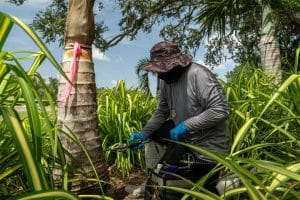

For coconut rhinoceros beetle control, trunk injection is one of the most effective professional treatment options available. Instead of spraying chemicals into the environment, injection delivers treatment directly into the palm.
Chemicals used
Trunk injections rely on systemic insecticides, meaning the product moves internally through the palm’s vascular system. In Hawaiʻi CRB programs and research, products containing imidacloprid and acephate have been used as part of injection strategies.
The specific product, dose, and timing depend on palm size, condition, and Hawaiʻi regulations. All treatments must follow label instructions and local guidelines.
The injection process (simplified)
- The palm is inspected for CRB damage and overall health
- Trunk size is measured to determine the correct dosage
- Small injection ports are drilled into the trunk
- Treatment is injected directly into the palm
- Injection sites are sealed and documented
Once injected, the product moves upward to the crown, where CRB feeds.
How effective is injection treatment?
Trunk injection provides targeted protection to treated palms. It does not rely on surface spraying and minimizes exposure to surrounding plants and soil.
The most important thing to understand is this: area-wide treatment works best. Treating one palm helps that tree, but treating multiple palms on the same property—or within the same neighborhood—reduces available food for beetles and lowers overall pressure.
Supporting actions that improve results
- Remove or properly manage palm stumps and green waste
- Avoid leaving decaying palm material on site
- Monitor palms regularly for new damage
Injection works best as part of a broader palm-care strategy.
Isaiah’s Tree Service Provides Coconut Rhinoceros Beetle Treatment Island-Wide
Isaiah’s Tree Service offers professional palm trunk injection treatment across the entire island of Kauaʻi. Whether you have a single coconut palm or a property with multiple palms, early evaluation and treatment can make a significant difference.
Because CRB rarely affects just one tree, Isaiah’s Tree Service can help property owners think in terms of property-wide or site-wide protection, especially for:
- Residential homes
- Vacation rentals
- Farms and orchards
- Commercial and resort properties
Local experience matters. Understanding Kauaʻi’s climate, palm species, and CRB activity patterns helps ensure treatments are applied correctly and at the right time.
Summary
The coconut rhinoceros beetle is a serious invasive pest now present on Kauaʻi. By boring into the crown of palm trees, it damages new growth and can eventually kill palms if left untreated. The most visible signs include V-shaped cuts in fronds, holes in leaves, and crown damage.
Trunk injection treatment is a proven, targeted method that delivers protection directly inside the palm. When used strategically—especially across multiple palms—it can significantly reduce CRB damage and help preserve the palms that define Kauaʻi’s landscape.
If you suspect CRB damage or want to proactively protect your palms, Isaiah’s Tree Service provides island-wide coconut rhinoceros beetle injection treatment and expert guidance. Call us today (808) 634-6488!
*Images used in this article by permission from Coconut Rhinoceros Beetle Response